
One Month on the Powys Diet
Powys County Councillor for Knighton Corinna Kenyon-Wade commits to The Powys Diet for one month. See how she got on here.
The Powys Diet by Corinna Kenyon-Wade
Week One
I first heard about the idea of a truly local diet, when I was sent on Carbon Literacy training by Powys County Council. A couple called the Smalls started the Fife diet in 2007, which now apparently has 6000 adherents. At least 80% of their diet is from Fife; allowing for tea, coffee and a few other things we have come to depend on. Reducing food miles cuts some carbon emissions, and stimulating the local market has to be a good thing – I read recently that Wales only produces 6% of its fruit and vegetables, while consuming just 5% of its main product which is sheep meat.
Fife though, compared with Powys, has a coastline (sea food) and a grain growing culture (oats and barley). As I found out, there is just one farm near Talgarth which grows strong wheat flour for bread-making, and despite Aberystwyth University researching strains of oats suitable for mid Wales, none it seems can be bought ready to make porridge. Sources of wine however are a different matter; there are four vineyards within 20 miles of my home near Knighton (although strictly one straddles the Shropshire border). A Radnorshire diet, a Powys diet, must at the moment be dependent on meat and potatoes, with dairy from Montgomeryshire and bread from Brecknockshire. My insides shift uneasily at the thought!
My stores
Own honey, apples, chilis, onions and garlic; with potatoes from Cwm Whitton Farm and Crown Prince pumpkin from Rhos organic. The eggs are from my neighbour. We have a few leaves, beetroot and herbs in a polytunnel, and leeks, cabbage and broccoli in the veg plot.
Conclusion – End of Week One
I went to the Supermarket today, the first time for a week and a half, but all I bought was cat food. What a change! This diet is certainly do-able if a bit repetitive, and rather heavy on the lard or the animal fats. The list of “extras” I allow myself grows a little every day. I started with the intention of just adding tea, coffee and marmite to the products available from Powys; but now I have added marmalade, hot chili sauce, oil when I ran out of butter and a squirt of tomato puree! I’ll see what Week Two brings.
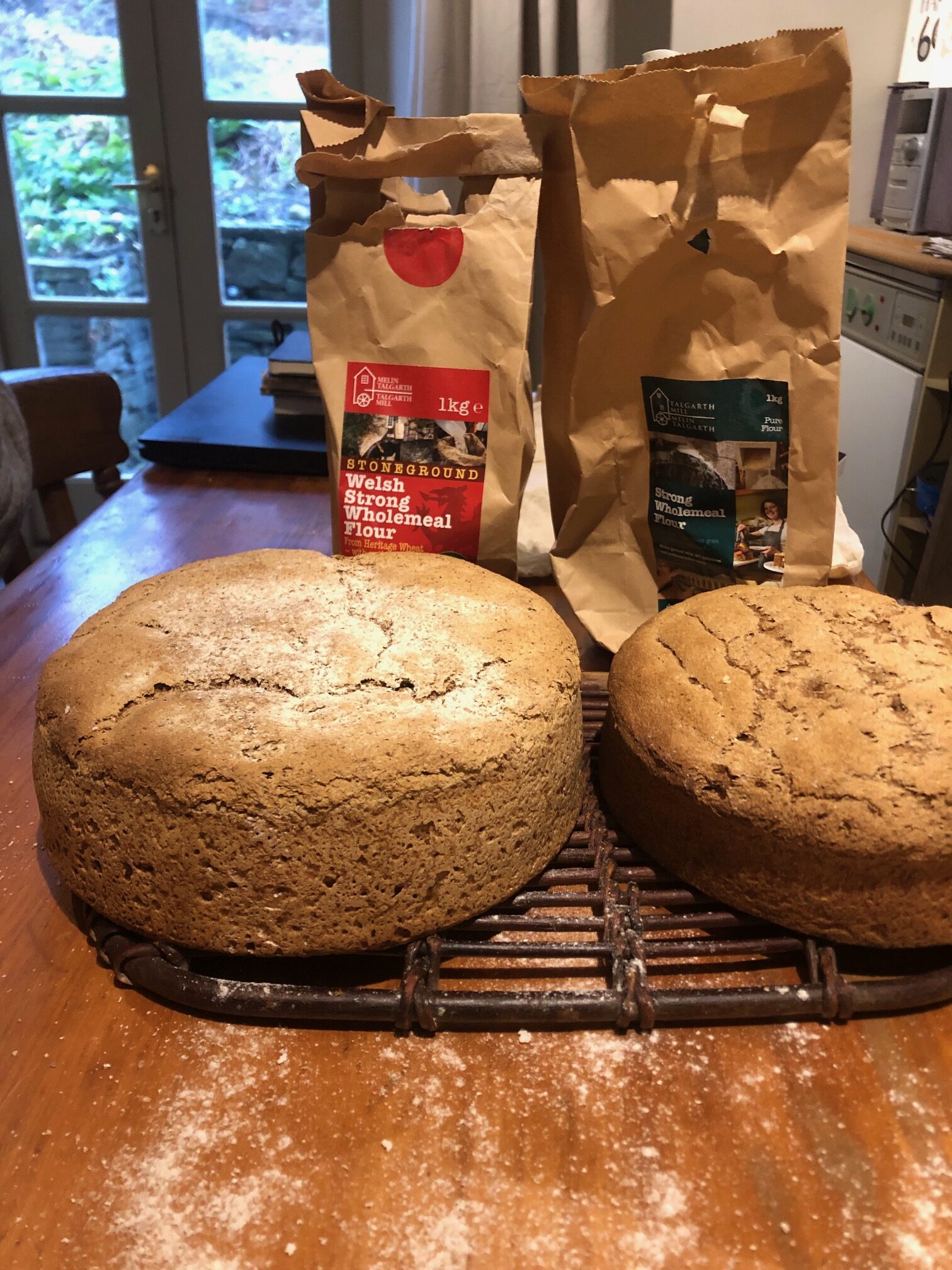
Bread flour from Llanigon
A fairly good result and really tasty. I enjoy with butter from Daisy Bank Dairy (Montgomery) and my own honey. And towards the end of Week One I’m afraid marmalade too…
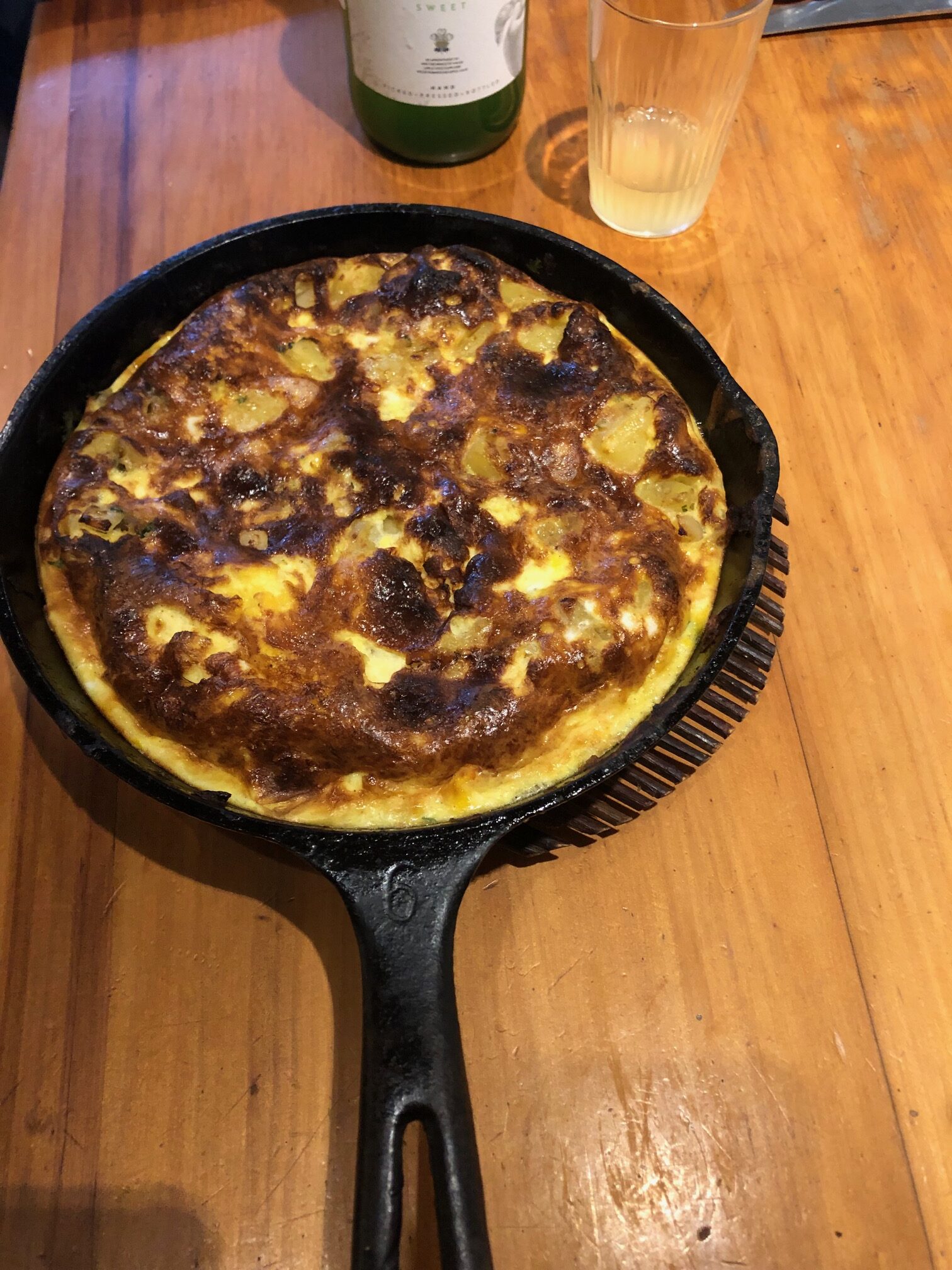
Frittata
An obvious one this; onions and parsley from me, potatoes from Cwm Whitton Farm, and eggs from my neighbour Tamsin. Fry an onion in butter and when lightly browned add some drained boiled potatoes chopped small. Add four eggs whisked with salt and pepper and chopped parsley and allow the bottom to set while the top remains moist. Finish under the grill – it should puff up.

Pumpkin soup
Fry an onion in butter. Add cubed 400gm of pumpkin, a chopped carrot and a chopped cooking apple. Add a chopped clove of garlic, salt and pepper, and a level teaspoon of marmite. Simmer for ten minutes and then liquidize. A really tasty, fruity, orange-coloured soup.
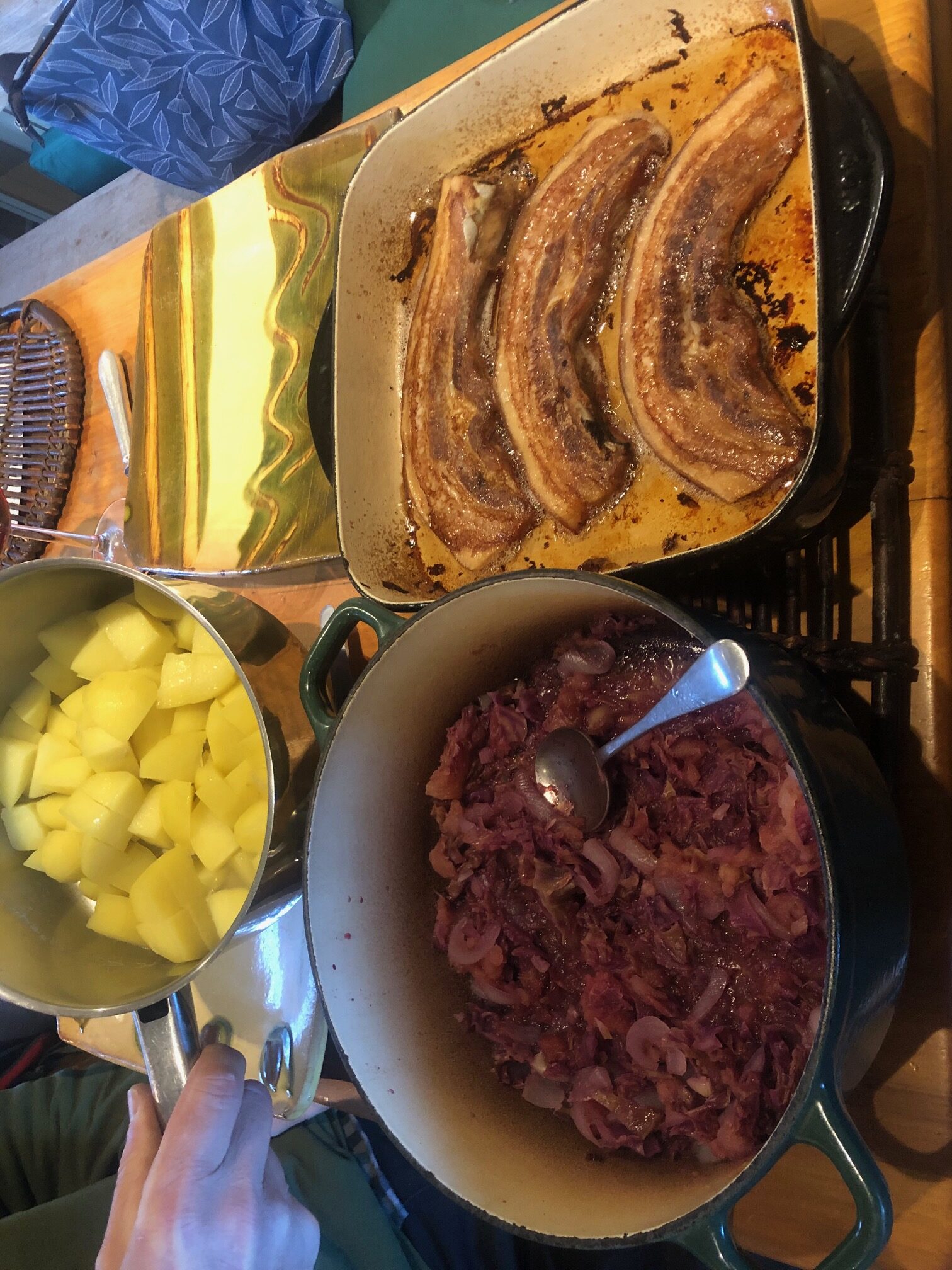
Sunday lunch; belly pork with red cabbage casserole
The belly pork is from Dan Weale of Builth Wells, who supplies the excellent Pugh’s butchers Knighton. The casserole is adapted from a Delia Smith recipe; place a chopped red cabbage (from the garden), a chopped cooking apple, chopped onion and garlic in a little red wine vinegar (improvise), honey and seasoning. Simmer.
Week Two
In praise of dairy and dripping..
Although some rape seed oils are grown in Wales, I can’t find any oils grown in Powys. For fats on the Powys Diet you have to rely on butter (in this case from the excellent Montgomery-based Daisy Bank Dairy) or dripping. Mention “dripping” to a room of older people and they will go misty-eyed about the good old days when the fat was saved from cooking the joint. The habit was lost for a few decades, but it is now time for a dripping renaissance!
I saved the fat from some well-cooked Builth-produced belly pork and made some pastry with it, using the Talgarth flour. I used it for an apple pie. It was difficult to work with, but actually made a light and crumbly pastry which didn’t taste as savory as you might expect!( I’m afraid I slipped here and used some non-Powys sugar too). I also made bacon; rub equal quantities of salt and brown sugar with a twist of black pepper into both sides of a chop or a small joint. Repeat morning and evening over two days, draining off the liquor. Really tasty.
Daisy Bank Dairy produces a couple of cheeses: one a brie-type flavoured strongly with chili (the Ruby Red), and the other a blue cheese, which I am keen to try but is so far is only a rumour. I believe that these are the only cheeses produced in Powys. Having received a cheese making kit for Christmas I thought I would now like to extend the range; I made ricotta cheese with a litre of whole Daisy Bank milk and a little citric acid. The result was good, but what do you do with it? Ravioli of course! When he came back merry from the pub, I got Andy to make pasta using 220gm of lightly seived Talgarth Mill flour and two eggs. He filled the ravioli with ricotta, parsley and finely diced cooked bacon. Using brown flour meant the pasta looked a bit worthy, but the taste was actually rather good, a bit like buckwheat noodles.
Conclusion
We’re eating much more seasonally than we would otherwise do, and while it could get a bit monotonous (so far, the only meat I have been able to source from Powys is pork) I have started to learn the names of the people that produce my food, and something about their values. A lot of the produce is organic and it’s not cheap, but I know the money will stay in Powys and the soil is looked after. But I could kill for a tomato!
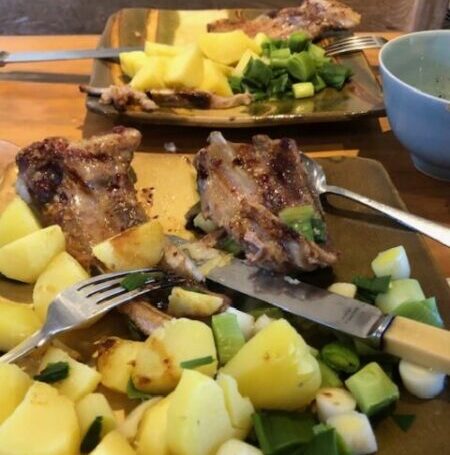
Powys Spareribs with Honey, Garlic and Chili dipping sauce
Pork from Builth. The leeks, garlic, chilli and honey were all produced at my home.
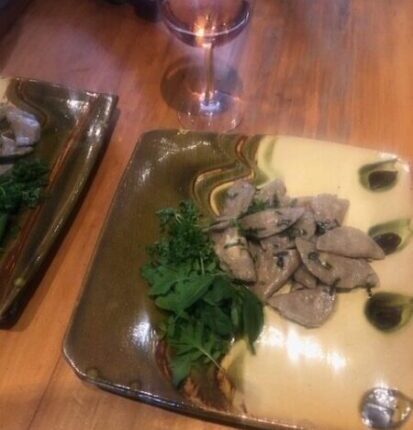
Ravioli and rocket with sage butter
Homemade pasta using Talgarth Mill flour filled with ricotta parsley and bacon topped with butter and fried sage leaves. A few leaves of rocket, still in the polytunnel,
are alongside.
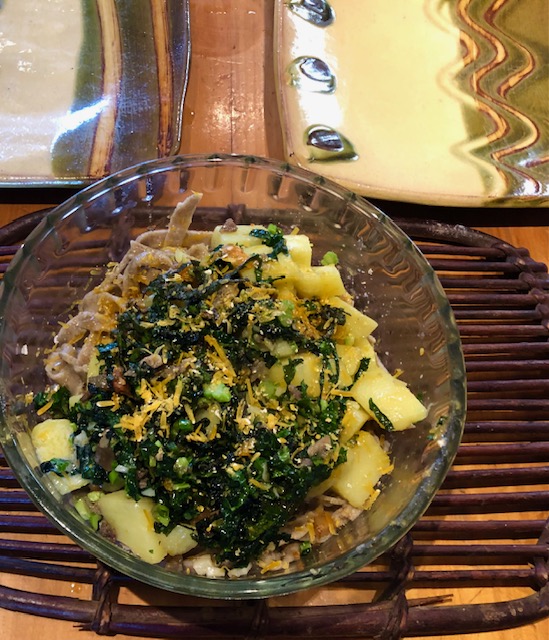
Powys pasta, potato, and kale with garlic, bacon, sage butter and Daisy Bank Ruby Red.
Based on a North Italian recipe using buckwheat noodles. Cook the pasta and chopped potatoes together and add the chopped kale halfway through. Drain. Fry the finely chopped bacon, add two chopped cloves of garlic. Top with sage butter and chili cheese (it had dried out in the fridge so I was able to grate it).
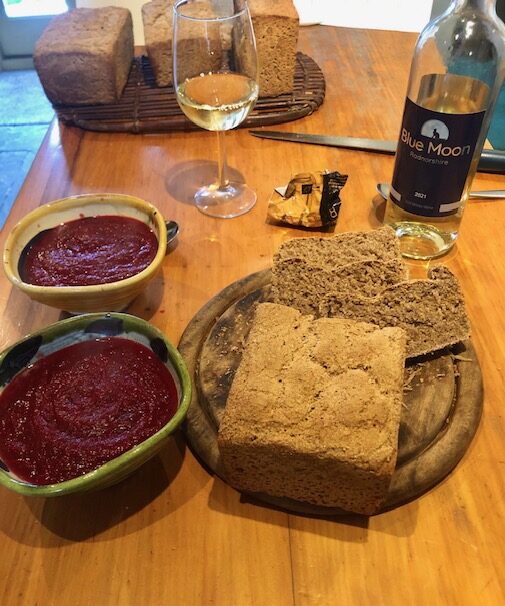
Beetroot soup
There are still a few beetroot left in the polytunnel. Boil, peel and add to a fried onion, carrot, garlic, a little celery seed and a half teaspoon of marmite. More about the Blue Moon wine from Crossgates vineyard next time, but I find it’s becoming an essential accompaniment to every meal.
Week Three
At last, Powys cheese! Yes, two types, a blue and a salty creamy brie, both from Daisy Bank Dairy. As far as I know, there are no other cheeses made in Powys. Served here with; a very, very fine white wine from the Montgomery vineyard (a small mortgage needed for this but worth it) and Fiesta apples from the garden (which are cox-like, can cope with cold wet Radnorshire weather and keep
well). Week three, and Powys is still revealing itself to me bit by bit. Despite the lack of tomatoes and chocolate, there are still taste highlights along the way.
Conclusion
I have to remind myself that I started eating produce solely from Powys, in January, because of the effect it might have on my carbon footprint. I did so also because of a theoretical interest in what can be produced locally, and in season. And I chose January partly because I still have stores of food that I squirrelled away in the autumn, or salad leaves that I germinated when there was still some sun (the real hungry gap comes in April, in my experience). As for the effect of all this on my carbon footprint however, I think it has gone up, essentially because I am eating more animal products. But I can still tell myself that the money I pay local food producers stays here in Powys, and serves to strengthen and widen the food-producing network.
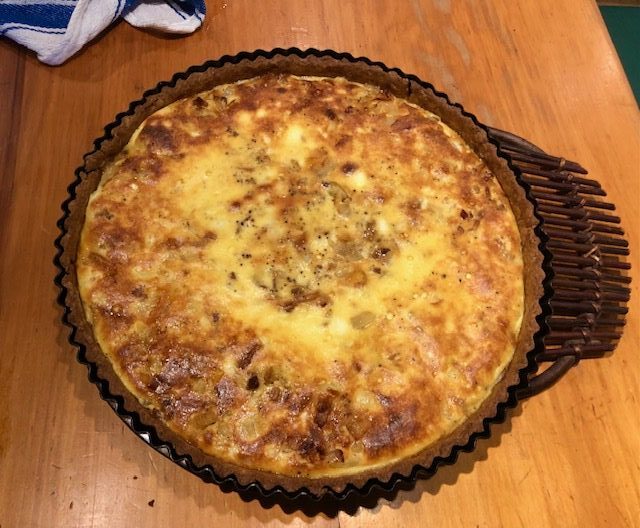
Bacon and onion quiche with ricotta
Filling Ricotta cheese (from week two) 120gm, finely chopped fried bacon (from week two) 120gm. 4 eggs, cup of creamy milk, one large onion lightly fried, salt and pepper.
Cheat’s Lardy Pastry Talgarth Mill Llanigon flour (sieved) 240gm, dripping (from lamb and pork this time) 160gm, 3 teaspoons baking powder, pinch of salt, a third cup water. Heat the water with the fat and salt until melted, remove from the heat, allow to cool a bit and add the flour and baking powder. Leave until room temperature. Roll out and bake blind for 10 minutes, before adding the filling. Really good pastry, really tasty quiche – and all from Powys!
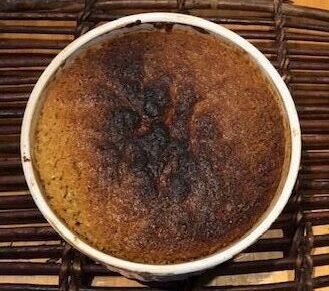
Apple pudding
Yes, I used sugar in this. A cake mix on top of apple puree is delicious with cream.
Topping Talgarth Mill flour (sieved) 100gms, butter 80gms, brown sugar 40gms and white sugar 40gms, one large egg.
Base Sweetened apple puree.
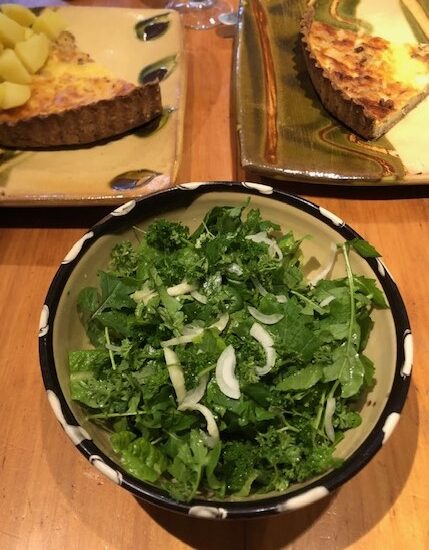
January salad
Leaves all from the polytunnel, all of which have survived -5 degrees Celsius. The Little Gem lettuces were sown in the autumn, as was the rocket. Parsley and mint keep coming up and we still have a few onions.
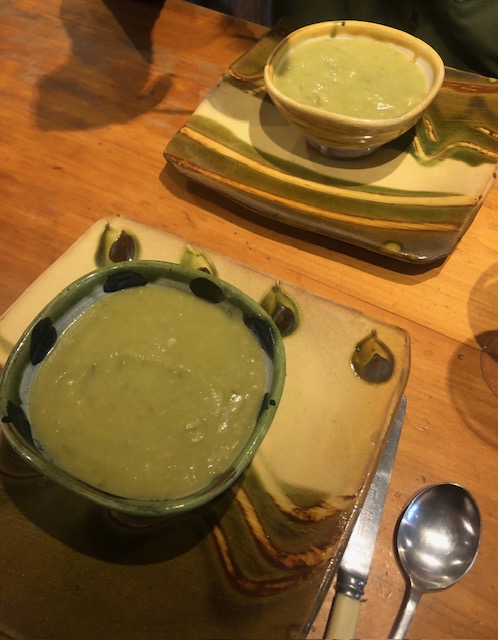
Leek and Potato Soup
Very simple but very good. Fry three onions in butter if you can. Add three large potatoes cubed and, in this case instead of stock, whey from making the ricotta. Cook for 15 minutes and then add three leeks, white and green parts, cut up small. Simmer for a further 10 minutes and then liquidize
Week Four
What do you do when you finish a diet? You have what you haven’t allowed yourself of course. I had chickpea curry and rice the next day, neither of which come from Powys or even Britain. It was indeed very tasty, but looking back over January I feel we have become more resourceful and creative in what we plan to feed ourselves. We made some great meals. I will be growing more this year, and definitely making my Powys bread simply because it is really tasty. Special thanks go to Rhos Organics for supplying the dairy and veg, Talgarth Mill for the bread flour, and …Blue Moon and Montgomery Vineyard for the best white wine!
Conclusion
What are the pros and cons of a local diet – why do it in the first place? I have to admit that for me choosing Powys as a locality was very arbitrary; a better choice might have been a twenty-mile radius from my home which, living near Knighton as I do, would have incorporated some of Shropshire and Herefordshire. My choice of locality did make me think about food networks more. For instance, my local butcher goes to the Ludlow market in Shropshire, which obviously complicates my hunt for Powys produce.
On the negative side eating a Powys diet would be harder to achieve in February and March when the real hungry gap occurs; in January I still had my stores from the preceding autumn’s produce and Rhos Organic still had their own cabbages and carrots. Eating locally means eating seasonally, and that means no fresh tomatoes to brighten up your plate. It would be hard to eat a Powys Diet if you are vegetarian, and almost impossible if you are vegan. No rice or lentils, which anyway would be imported from another continent. And no oil – I couldn’t find a source of rapeseed oil in Powys. Lastly, this diet is heavy in meat and dairy, which means lots of carbon emissions, despite it having travelled relatively few food miles.
On the plus side, over the month I didn’t go to a supermarket other than for cat food and toilet paper, and my shopping experience was much more personal and interesting, meeting small producers and suppliers. That was a big change in my lifestyle, and there was also a lot less packaging to deal with. My approach to mealtimes was more thoughtful, and I developed a greater respect for my raw ingredients. We did encounter some great food and did have some very enjoyable meals.
Eating local supports local people, and improves our skill level, making us better able to face whatever the changing climate is going to throw at us. And I guess that is good in itself. And most of the food we have been eating this month is organic and so better for the soil and wildlife
Finally, thanks should go to Chloe and Cultivate for the work they do and for putting this on the web!
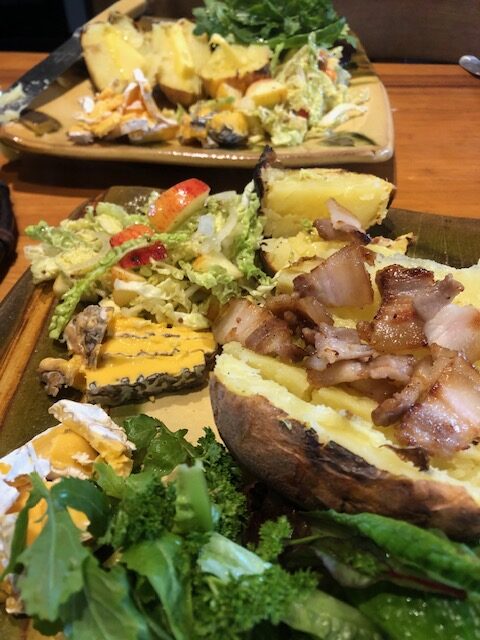
Baked potato
One or best meals and actually one of the simplest; baked Belana potato from Cwm Whitton Farm, Savoy cabbage from Rhos Organics Knighton, salad leaves from our polytunnel and apple from our store. The delicious cheese (blue and brie types) from Trefaldwyn via Daisy Bank Dairy and the bacon, ultimately from Dan Weale of Builth, but home-cured by us.
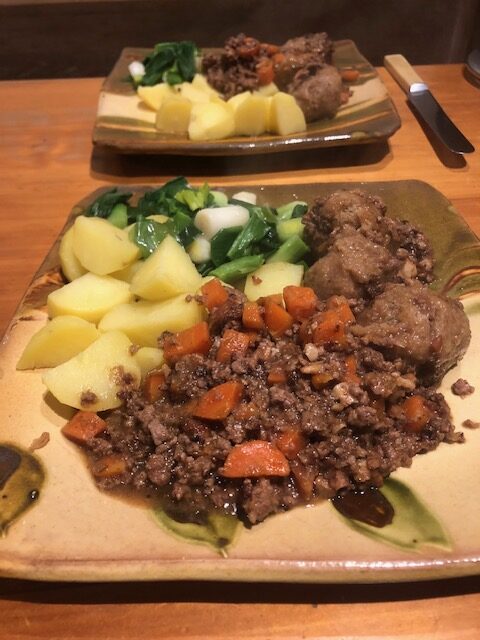
Venison and carrots with herb dumplings
The venison mince is wild from Crai near Senneybridge, provided by George’s Butchers of Talgarth. Fry onions and bacon with the mince and add bayleaf, seasoning, flour and water/wine. The dumplings are made with Talgarth Mill flour, baking powder, butter and thyme. Carrots are from Rhos Organic, leeks are mine. Oddly, buying chicken or lamb from Powys seemed to be complicated in the two butchers I visited over the month, so pork and deer it mostly was.
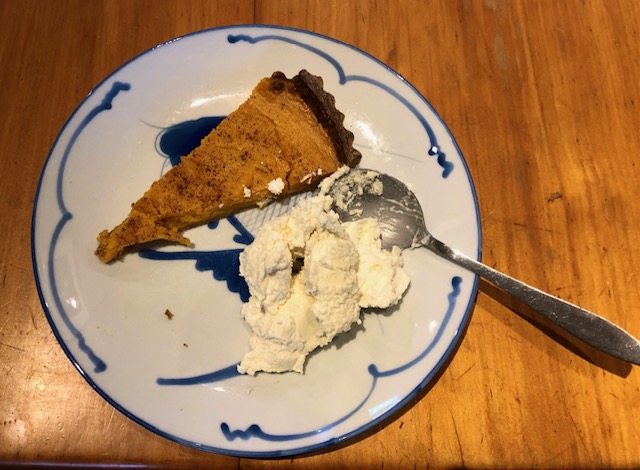
Pumpkin pie with honey ice cream
The honey ice cream was made with a neighbour’s runny honey and whipped cream from Daisy Bank Dairy. Just mix and freeze. The pumpkin pie filling was made with around 400gm of Crown Prince pumpkin (from Rhos Organics) cubed and cooked, 250ml Daisy Bank Dairy cream, two eggs and 180gms of honey. Liquidize everything and pour into a pre-cooked pastry case, made with cheat’s pastry. Melt 125gm each of butter and lard in 100ml of water and a pinch of salt. When cool, add 350gm sieved Talgarth Mill flour and 2 tsp baking powder. Just before taking the pie out of the oven glaze with more honey and a little nutmeg (unfortunately not from Powys)…
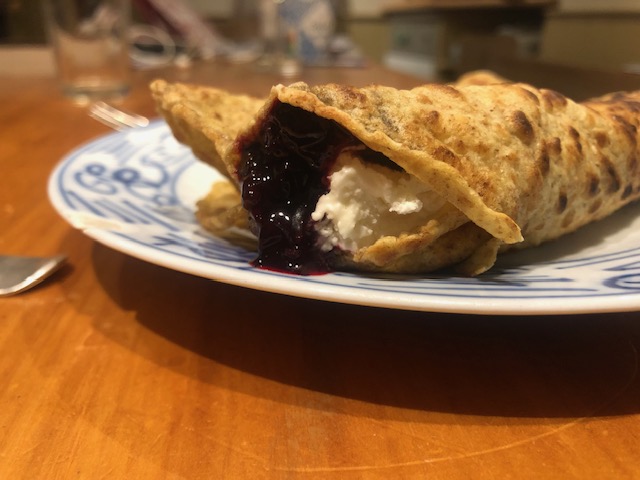
Pancakes with blackcurrant compote and honey ice cream
Blackcurrants from the garden via our freezer. I did use some sugar as well as honey here, but it was worth it.


An excellent read and well done committing to the Powys Diet! Walk the talk!!